
At a glance
- 01
One kit per door
The operator, buttons, lock and alarm come together and are installed together.
- 02
Locking tells everyone
Lock the door and the indicator shows occupied, with the outside button disabled.
- 03
Help within reach
An emergency call button lets the person inside signal for help.
- 04
Matched to the door
Kits are sized and wired for your door, frame and wall.
A barrier-free washroom only works if a person can get in, lock the door, and get out again without help. The door is usually the hardest part. We sell barrier-free washroom kits that bring the pieces together so they act as one system, and we install them for businesses, institutions and building owners across Kitchener, Waterloo, Cambridge and beyond.
What a kit brings together
The exact parts depend on the door and the building, but a typical kit includes:
- A power door operator, sized for the washroom door. See automatic door operators for how duty is chosen.
- Push buttons inside and outside, standard, wireless or touchless.
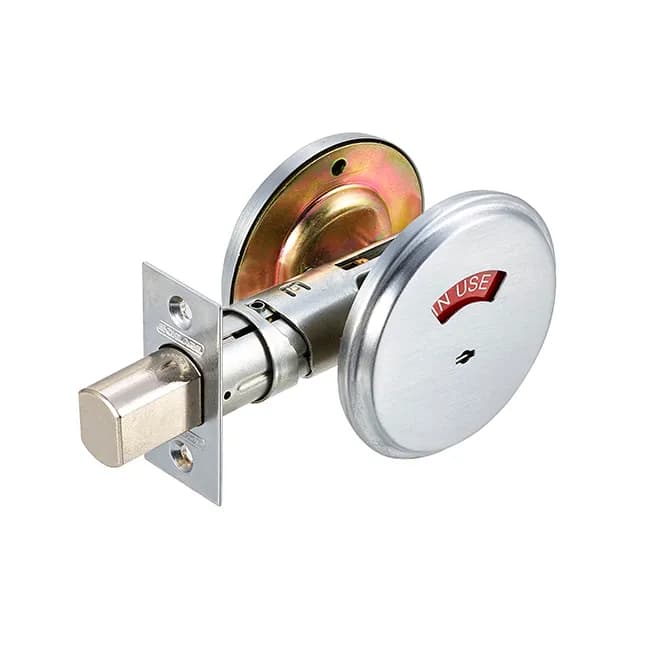
- An occupancy-indicator lock, which shows occupied or vacant on the outside of the door.
- An emergency call button inside, with a light or sounder outside to alert staff.
- The control wiring that makes all of them talk to each other.
Parts commonly come from brands we carry, such as Camden for buttons and controls and Schlage for locks. We confirm the components for your door before ordering.
How it works in use
- Someone arrives and presses the outside button. The operator opens the door.
- Inside, they press the inside button or let the door close, then lock it. The indicator outside changes to occupied, and in a typical setup the outside button stops opening the door.
- When they are done, they unlock the door and press the inside button. The operator opens it so they can leave without pulling a heavy door.
- If they need help, the emergency call button signals outside so staff know to come.
That sequence is the whole point of a kit. Bought piece by piece from different suppliers, the parts often don’t interlock: the outside button opens a locked door on someone, or the indicator shows vacant while the room is in use.
Why the details matter
Button height and position affect whether a wheelchair user can reach them. The operator speed has to be slow enough to be safe and fast enough to be useful. The lock has to be easy to work with limited hand strength, which is why levers and large thumbturns are used rather than small knobs. And staff need a way to open the door from outside in an emergency. We set each of these up when we install the kit, and we show whoever runs the building how it behaves.
Ontario accessibility context
Ontario’s accessibility rules come from two places. The Accessibility for Ontarians with Disabilities Act sets out the province’s accessibility standards, and the Ontario Building Code includes barrier-free design requirements, including universal washrooms, for many new buildings and major renovations. Requirements depend on the building’s use and the scope of work, so your architect, designer or building official should confirm what is needed. Our job is to make the door hardware deliver it.
New builds and retrofits
On new construction, we work from the hardware schedule and coordinate the wiring with the electrical contractor before walls close. On a retrofit, wireless buttons and careful routing keep the work tidy in a finished washroom. Either way, the existing door and frame need to be sound; a sagging door or a weak frame gets fixed first, often with new hinges or a continuous hinge from our commercial door hardware range.
Testing and upkeep
A barrier-free washroom is only useful if every part works on the day someone needs it. Whoever looks after the building should test the emergency call button regularly and confirm someone hears or sees the alert. Check that the indicator changes when the door is locked, that the outside button won’t open a locked door, and that the operator closes the door fully. Wireless buttons use batteries, so replace them when they weaken. If anything behaves oddly, call us before it becomes a complaint.
Getting a kit for your washroom
Send us a photo of the washroom door from both sides, the door’s size, and whether there is power nearby. Request a quote, call 519-894-7055, or stop by the shop at 300 Manitou Drive to talk it through. We work across Waterloo, Kitchener and the rest of the region.
Questions people ask
What’s included in a barrier-free washroom kit?
Typically a power door operator, push buttons inside and out, an occupancy-indicator lock and an emergency call button with an outside signal, plus the controls that tie them together. We confirm the exact parts for your door.
Does the Ontario Building Code require a universal washroom?
Many new buildings and major renovations must include barrier-free washrooms under the Ontario Building Code, depending on the building’s use and size. Your designer or building official can confirm the requirement for your project.
Can staff get in if someone inside needs help?
Yes. Occupancy-indicator locks used in these kits generally have an emergency release on the outside, and we show staff where it is and how to use it.
Can a kit be added to an existing washroom door?
Usually. If the door and frame are in good shape, the operator, lock and buttons can be added. Wireless buttons help avoid opening finished walls.
Why buy a kit instead of separate parts?
Because the parts have to interlock. A kit makes sure locking the door disables the outside button, the indicator matches the lock, and the operator, lock and call button work in the right order.